In December 2016 I arrived in Italy. I was twenty-five. I spent three years in a camp in Brianza, learned the language over a steel counter from two cooks who spoke no English and would not speak English to me, washed dishes for a year and cycled home at midnight through the snow. This is an immigrant memoir of Italy, and it is about the work.
Between Immigrants and Italians is out in November.
What this immigrant memoir of Italy is actually about
It is about work.
I say that first because most books with an immigrant on the cover are about the crossing: the boat, the desert, the arrival. Mine is not. The crossing is somebody else’s book and I have already written that one.
This is what happened afterwards, over nine years, in the jobs that actually fill a life. Restaurant kitchens from 2017 to 2019. Cold rooms behind Chinese restaurants and cellars under bars. Building sites. An estate agency where I sold Italians the dream of a home and heard the line go quiet at a brother’s name. Sixteen-hour days on a ferry to Croatia, paid as eight. And since 2023, the data centres on the plain outside Milan, the grey sheds with no name on the fence that keep the world’s memory cold.
The internet does not live in the sky. It lives in those sheds, and it is wired and kept alive by men in heavy boots, and I am one of them.
Papa, and learning a trade in Italy
The first man who taught me refrigeration was a short, thin Senegalese of sixty that everybody called Papa. Thirty Italian winters had boiled him down to wire and will.
He put a spanner in my hand on the first morning and told me it was a promise: that the thing you touch works when you are gone, and nobody is hurt by what you did. He taught me how to walk into a room where nobody wants you, and at a shopping centre in Rozzano, on a day we lost the money, he taught me never to beg for a job.
He is in the book. He is the reason I have any right to complain in it.
Three movements, and then the photographs
The book is in three parts: the I, the ME and the WE. One man’s work, then what the work did to him, then what any of it means for the rest of us.
On Easter Monday 2019, after a year of standing in industrial chemicals, I
photographed my own hands, because I knew nobody would believe me later.
Those photographs are the last thing in the book.
The names in the book are changed. The truth is not.
Who this immigrant memoir is for
If you are Gambian, West African, or diaspora anywhere, parts of this will be so familiar it is uncomfortable, including the chapters that are critical of our own.
If you are Italian, this is an account from the other side of a debate you have been hearing about for twenty years, written by someone who is not asking you for sympathy and who is honest about what Italy got right.
And if you work in data centres, construction, kitchens or facilities anywhere in the world, you already know most of this and nobody has written it down for you. That is the part I would most like you to argue with.
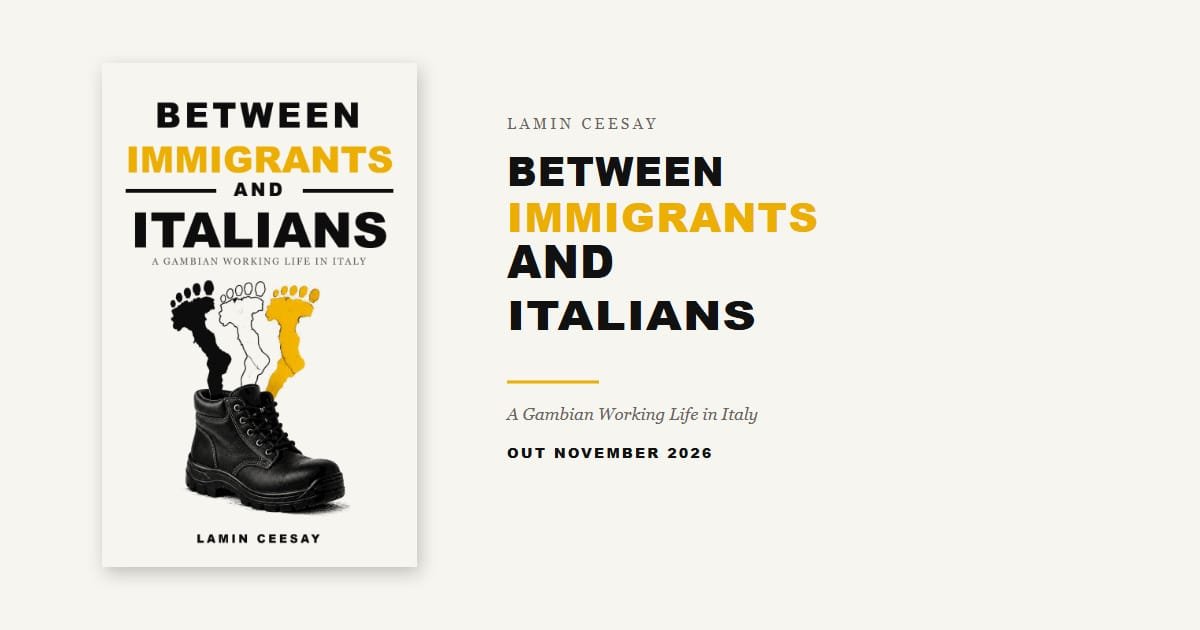
The cover, and the boot on it
The boot on the cover is mine. It is the one I actually wear to work.
If you look at the sole it says “Don’t worry, be happy”. I did not plan that, I only noticed it one day, and by then it was too late to pretend the universe had not made the joke first.
When the book comes out, and how to read it early
Between Immigrants and Italians is published in November, in English, in paperback and for Kindle.
Before then I am sending it to people who will read it and tell me honestly what they think. Not kindly. Honestly. If a chapter is boring I want to know while I can still do something about it.
If you want one, send me a message through the contact page or reply to me on Instagram or Facebook, and I will send it over. There is no payment and no obligation to be nice about it.
Frequently asked questions
What is Between Immigrants and Italians about?
A Gambian man’s working life in Italy between 2016 and today: a migrant camp in Brianza, restaurant kitchens, refrigeration and building sites, an estate agency, and the data centres outside Milan. It is a book about work rather than about migration routes.
Is this an immigrant memoir of Italy, or a migration story?
Both words get used loosely, so it is worth separating them. A migration story is about getting somewhere. This is an immigrant memoir of Italy in the older sense: what the years afterwards were actually like, in the jobs, with the documents, among the people.
Is it a true story?
Yes. It is a memoir. The names of most people and companies are changed, for their sake rather than mine, and the events are as they happened.
When is it published?
November 2026, in English. A paperback and a Kindle edition.
Is there an Italian edition?
The translation is finished and it is with readers and publishers. It is not published yet, so please do not wait for it on Amazon.
Why is the author’s name five letters?
Because it is Lamin, and in nine years in Italy almost nobody has managed it on the first attempt. There is a chapter about that, and about being called Senegalese by people who have never asked.
Does the book include photographs?
Yes, fifteen, taken by me. They are at the end of the book in black and white, and on this site in colour.
How can I read it before it comes out?
Message me. I am sending review copies to anyone who will read it and give an honest opinion, right up until it is published.
Where is The Gambia?
On the Atlantic coast of West Africa, surrounded by Senegal. It is the smallest country on the African mainland. There is a country called the Gambia, and that sentence is in the book more than once for a reason.
If you would rather hear about it when it is out, the newsletter is
the one place I always say so first.

