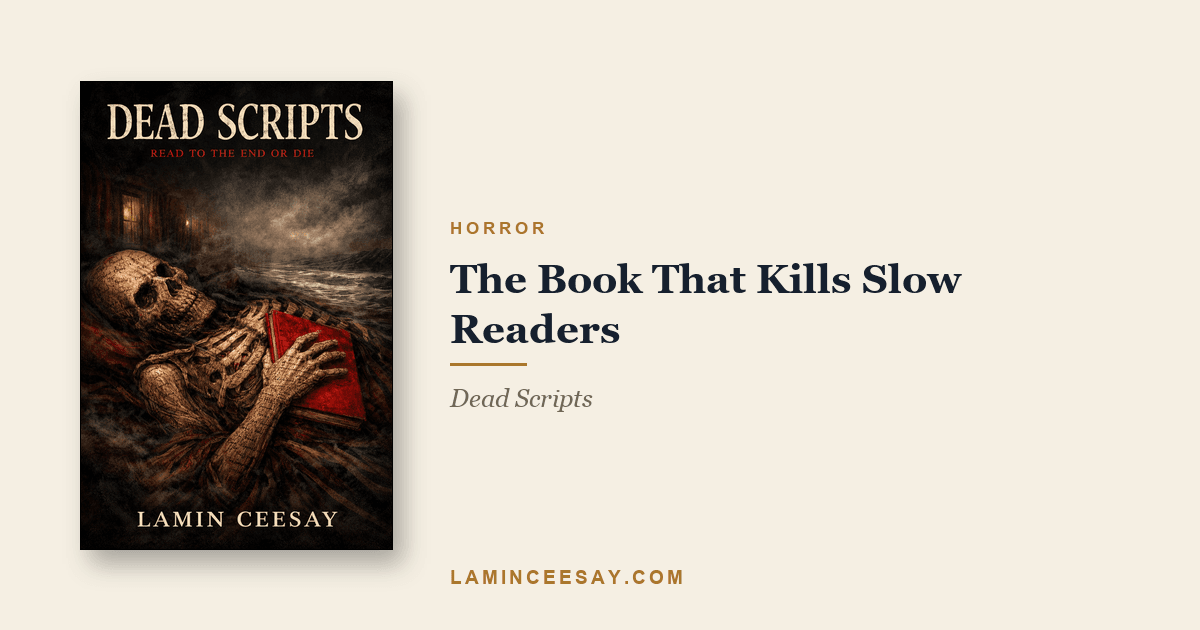
Every horror tradition has a cursed object. The ring you shouldn’t wear, the tape you shouldn’t watch, the doll you should absolutely have left at the estate sale. When I sat down to write a Gambian horror story, I knew immediately what my cursed object had to be: a book.
Dead Scripts runs on one rule, and the rule is the whole horror: whoever opens the red book must read to the end, or die, slowly, exactly as slowly as they read. The book has no title. The book writes itself, faster than you can read it. And it is polite enough to warn you on page one: you have only yourself to blame now.
Two writer friends find it on a beach holiday in The Gambia. Aqib, the careful one, who promised his wife a holiday with no books and doesn’t even like the colour red. And Jelani, curious, brilliant, doomed Jelani, who pulls the thing out of the hands of a skeleton kneeling on the shore, a skeleton whose bones are covered in words like a book charred in a stove, three of them legible: curiosity. life. revenge.
Around them, I built the Apollonian Hotel, which I am fonder of than any haunted house I’ve read. Staff are dying with words on their bones, and management is worried about reviews. The owners smoke and eat olives while a corpse turns to a skeleton in the staff room. And at the desk sits my favourite character in anything I’ve written: Mr Banjo, the receptionist, who logs every guest IN and never cares why they leave, only that they come back on time. Asked whether the guests are free to go out after curfew, he delivers the line the whole hotel lives inside: “In peacetime, you are all guests; in troubled times, prisoners. We become the prison’s god to protect you.” Watch Mr Banjo. That is all I will say.
But the reason the book kills its readers slowly, rather than instantly, like a decent curse, is that I wanted the horror to be an argument. Aqib argues that ignorance is a superpower: “To hold no information can be the greatest power a man has: an immunity to other people’s opinions and ideas. Purity.” Jelani argues the opposite: “The more you know, the more you are”, and that a man who stops chasing what he wants to know becomes an imitation of everyone around him. The red book is the tiebreaker. Curiosity is a beast, the one beast man cannot resist; the tale says we were thrown out of Eden for exactly this. Jelani opens the book knowing the price, with food for forty-eight hours and a friend to feed him orange slices while he reads for his life.
Does he make it? I will tell you only what the last chapter admits: it is past eleven at night, the lanterns in the cabin are lit, nobody living lit them, and there is someone in the cabin, with Jelani. The book ends on that image. Readers write to me, outraged. I regret nothing. A story about the danger of needing to know had to end by leaving you needing to know.
Would you read the red book? Be honest about your reading speed before you answer.
Dead Scripts is now available on Amazon in paperback and Kindle editions. CLICK THIS AMAZON LINK
If it moved you, an honest review is the kindest thing you can leave a writer.
Follow along on Instagram & X: @writerlamin · Facebook: /LaminXceesay