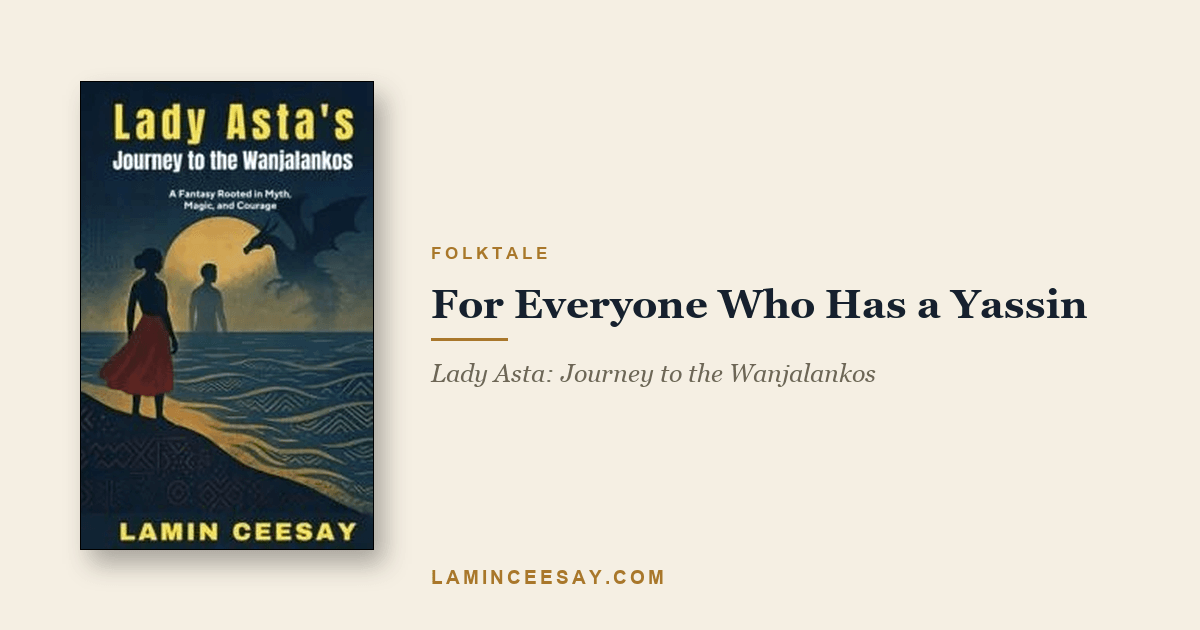
Orpheus went down into the underworld for a lover. Most of the old quests run on romance: the prince climbs for the princess, the knight rides for the queen. When I sat down to write Lady Asta, I wanted the engine to be the love our tales actually run on, where I come from, the love nobody writes ballads about because it is too ordinary and too enormous: a best friend.
Asta is an orphan. Her parents died when she was ten, and the tale says everything about what came next in one line: “Yassin became her sister then, her family, her whole village in a single girl.” So when the dragon Ninki snatches Yassin from the shore, chosen as the sacrifice for the Wanjalankos, the millennium festival where a dragon buys its immortality with a human life, there is no question in Asta at all. No living human has ever been to the land of the Wanjis. No living human has ever returned. She goes anyway.
The world she crosses is the one I inherited at the fireside, written down as faithfully as I could. Mingo, the trickster-guide who walks the sea, the land and the air, and who saves drowning fishermen because “everyone has his own work to do.” Kerring, the one-eyed blacksmith whose family has forged the dragon’s food for centuries, and who has mistaken that servitude for destiny, until Mingo tells him the line the whole tale hangs on: your destiny is not fixed; every second offers you the chance to change it, or to keep the old one. The Gottos, who build burial domes for dead dragons. Twin wave-controlling sisters taller than Kilimanjaro. The tallest man in the ocean, waist-deep in the sea and head in the sky, moving an inch a year, whose pores hold every soul the water ever took. And a living rope that carries you up through levels of sky that seal shut behind you.
The Mandinka incantations are printed exactly as they are sung, Ninki woo Ninki, Baba Ninki woo Ninki, because that is how they work. When the dragon asks who is at his pond, you must answer in song. I ask readers to say them out loud. The tale is older than the page it sits on.
But under the marvels, this is a story about the cost of rescue. At the top of the world, when the vessel must be filled with blood to wake the only being who can unmake an immortal, there are no volunteers for a sacrifice. Asta cuts her own left arm first. Then her right. Saving someone, in the tales I grew up on, is never a speech; it is a payment, and the hero pays it herself.
And there is the ending, which I deliberately planted on the very first page, where most readers only find it on the way back. I will not give it away here. I will only say that this is also a tale about grief, and about what the heart does at night with the fear of losing the one person the world has left you. When you finish it, read chapter one again. It is a different book the second time.
For everyone who has a Yassin, you know who they are. Maybe send them this one.
Lady Asta: Journey to the Wanjalankos is now available on Amazon in paperback and Kindle editions. CLICK THIS AMAZON LINK
If it moved you, an honest review is the kindest thing you can leave a writer.
Follow along on Instagram & X: @writerlamin · Facebook: /LaminXceesay



One Comment