The question came to me whole, the way the best lines do: And if the Sun were for sale, would Africa still have it?
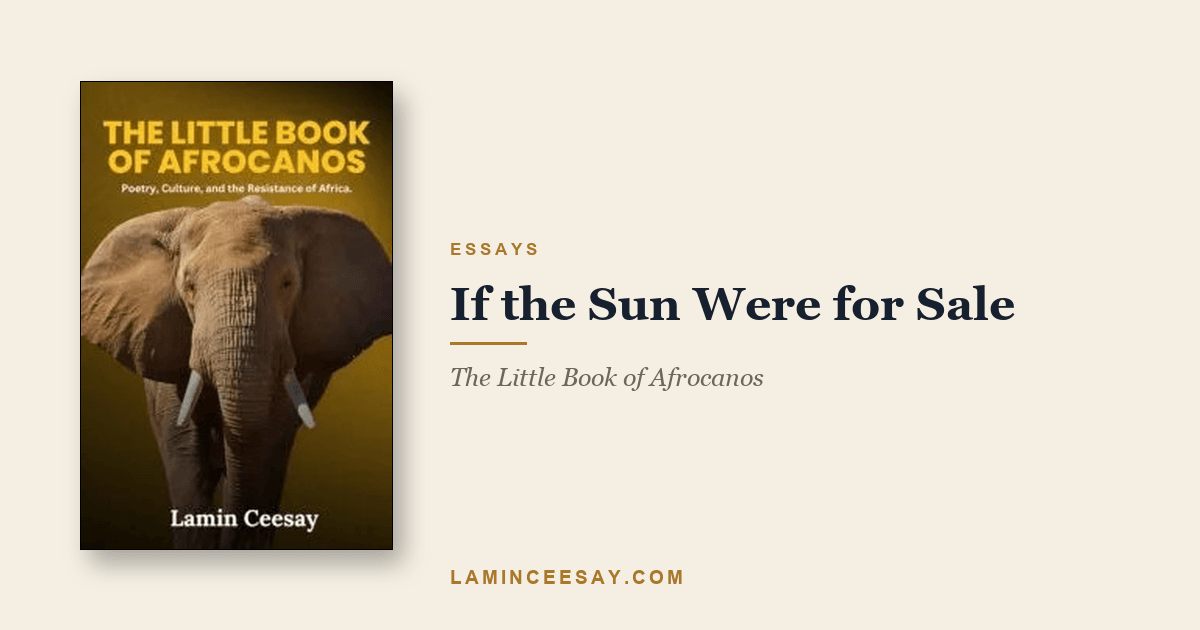
Everything else in The Little Book of Afrocanos grew around that question. Because the honest answer stings. They took the gold. They took the diamonds, the rubber, the people. The Brits, in my Gambia, did not even leave the roads they built. If the Sun had a price and a port, would anyone believe it would still be shining over Banjul?
The book that grew from that question is not an essay collection in the polite sense. It is a spoken-word manifesto: five movements, written to be heard, in the cadence I inherited from the griots and the fire I inherited from the street corner. It praises, it rages, it names names, and it does not calm down, because I have noticed that “calm down” is what history says to Africans just before it changes the subject.
It begins with a roll-call of warriors, because we forget our own register: Yaa Asantewaa, who told the British to go home or be killed. Shaka Zulu. Steve Biko. Queen Amina of Zazzau. Kunta Kinteh, of my own little Gambia. Malcolm X, defiant and word-gifted. And Nkrumah, the man I believe God showed the clearest picture of what Africa could be, whose warning we are still ignoring: we do not have time; if we do not come together, we will fail.
It walks through my tiny country’s three regimes, the gentle Sir who paved the roads, the dictator who loved The Gambia and hated Gambians in the same breath, and on the third day, the griot Jaliba Kuyateh prayed would be favourable. Sorry, Jaliba. The Sun has not shone since.
It tells my own origin story: the ceremony where the elders wrote words in my palm with carbon ink and an eagle-feather pen, and I licked it, and drank from the pot, and whatever a boy’s mind gravitates to after drinking that ink is what he becomes. I sang. So here I am.
And it does the harder thing, the thing the colonisers’ critics rarely do: it turns and faces us. Sankara was murdered by an African. Nkrumah was ousted by Ghanaians and died in exile. The old saying carries the whole chapter: if there is no enemy within, the enemy without can do us no harm.
But the book is a love letter before it is a war letter. Africa means family. Africa means home, Gambia, Zambia, Somalia, the ancient names ending in “ai”, the Mandinka word for home. The last movement looks forward: the AI babies raised on touchscreens, the deserts that could power the world, the oldest and youngest continent deciding what to do with itself.
It ends where every honest manifesto must end, not with the enemy, but with you: Today, you decide whether you will be a warrior or a weakling, for the day or for your lifetime.
I know which I decided. The book is my evidence.
The Little Book of Afrocanos is now available on Amazon in paperback and Kindle editions. CLICK THIS AMAZON LINK
If it moved you, an honest review is the kindest thing you can leave a writer.
Follow along on Instagram & X: @writerlamin · Facebook: /LaminXceesay



2 Comments