Do the dead read books?
I ask because I wrote one for a dead man. His name was Yun, and he arrived in my life the way most guests arrive: through a booking. An old Belgian at my door in The Gambia with two big shopping bags full of books, electrical gadgets, and cold mortadella sandwiches. I gave him a room for three weeks. He gave me enough life for a book.
We were an unlikely pair. He was old and European and stubborn; I am Gambian and, as my friend Lorenzo once put it, an “idiot iconoclast”. We chased a cuttlefish export deal that came to nothing. We crossed into Senegal without much of a plan. We argued about God, butterflies, moderation, and whether anything means anything. He fell face-first in the sand like Michael Jackson dancing “Billie Jean” and told the laughing children, “I can handle it, it’s okay.”
Then he died. And I discovered that grief for a friend is a strange, unhoused thing. There are rituals for mourning the family. There is no ritual for mourning the man who ate your food, questioned your religion, and improved your life by accident.
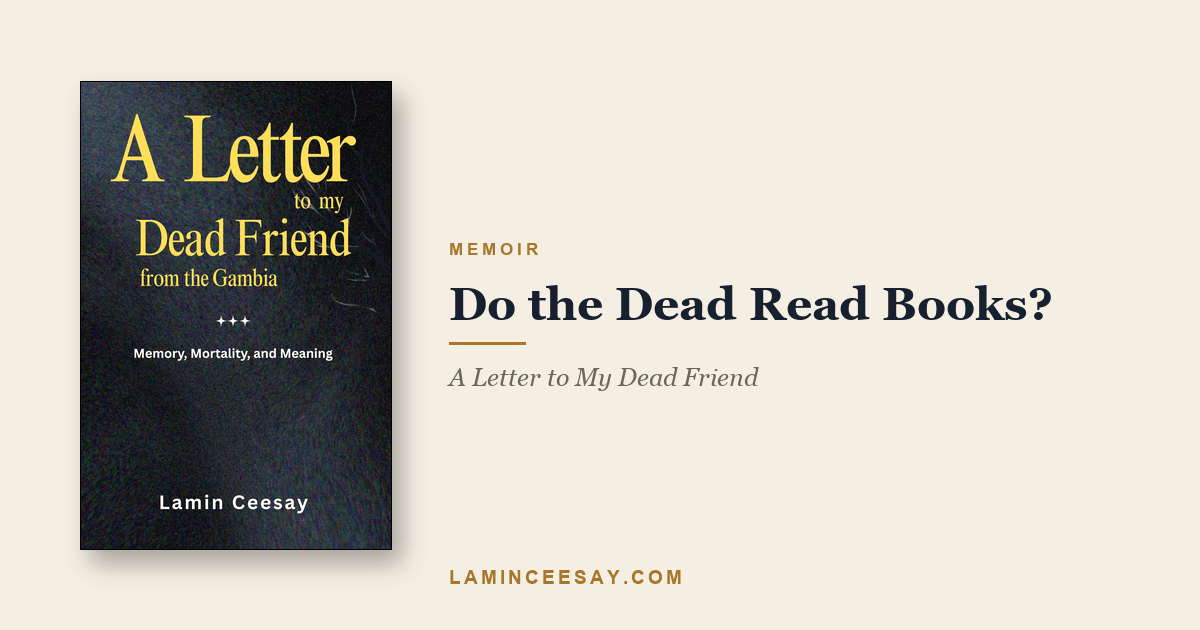
So I did the only thing I know how to do: I wrote him a letter. One long letter, whispered, as I say in the book, “through the tiny holes of your grave”. It became A Letter to My Dead Friend from the Gambia.
People expect a grief book to be solemn. Mine refuses. Yun was not solemn; honouring him with solemnity would be a kind of lie. So the letter laughs. It gossips. It complains about him. It tells him things I never got to say and answers questions he never got to ask, because, as I warn him early on, “You will not answer this letter, so I will write and answer myself too.”
But under the laughing, the letter keeps arriving at the same three stations: memory, mortality, and meaning. What do we keep of the people we lose? What do we do with the knowledge that we are, all of us, “creatures of a single season, and that season is death”? And what was Yun searching for, right to the end, a brave old man “who missed life’s essential lessons”?
I do not resolve those questions. This is not a moralistic letter, and I tell him so. But I did come away with one instruction, and I will give it to you the way the book gives it: ready yourself to live every day as your last, and most important, day.
If you have ever lost a friend, if you have ever spoken out loud to someone who could not answer, this book is for you. And if you happen to see an old Belgian up there, arguing with the management, tell him his letter is in the post.
A Letter to My Dead Friend from the Gambia is now available on Amazon in paperback and Kindle editions. CLICK THIS AMAZON LINK
If it moved you, an honest review is the kindest thing you can leave a writer.
Follow along on Instagram & X: @writerlamin · Facebook: /LaminXceesay