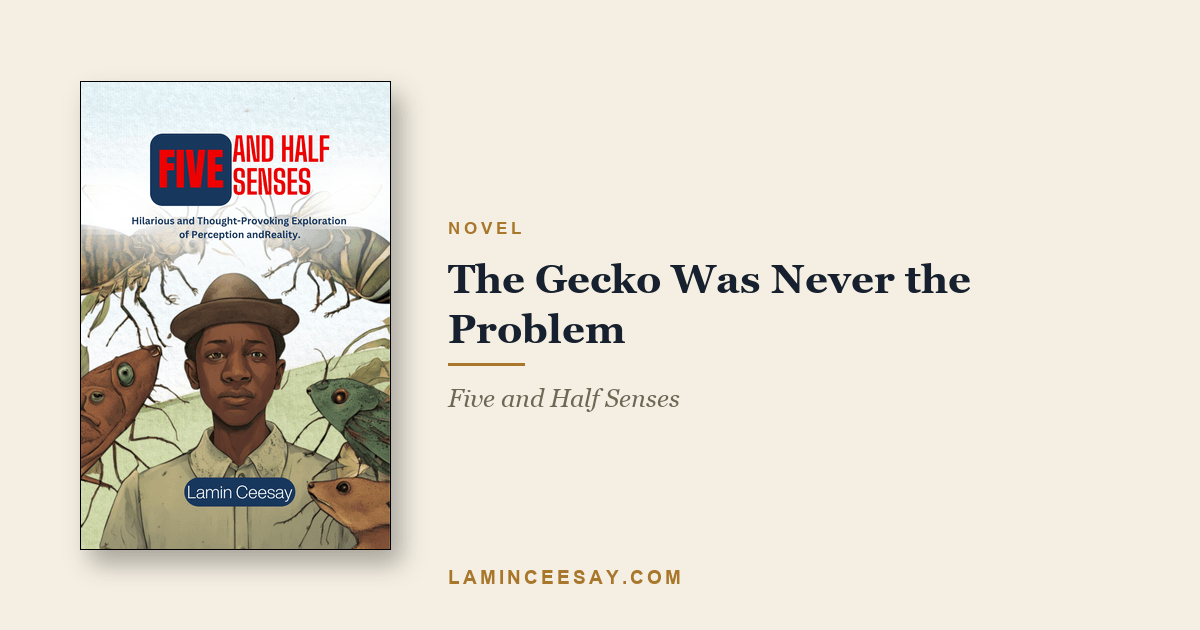
Zeek Zillan, the hero of my first novel, is a bank teller in Figtree Town whose hands tremble so badly he types a row of extra zeros into a lucky customer’s account. His manager sends him home: ninety days to fix himself, or lose the job. And what is wrong with Zeek is, on the surface, ridiculous: he is mortally afraid of a gecko.
Not geckos in general. One Gecko, capital G, who lives in his house, alongside Nyepeto the cockroach, who critiques his life choices from under the sofa; Ratty the rat, who reviews his kora practice (“Is it my ears this man wants to learn his craft with?”); Susula the mosquito; and Spidy the spider, his one loyal fan. Zeek hears them all, word for word. Five senses every man is born with; Zeek carries a sixth that is only half-grown, the half-sense, which hears what lies beneath a thing: the talk of animals, the breathing of the dead, the heartbeat under a kora string. A griot‘s inheritance, and a griot’s burden. It has never once let him rest.
Readers ask me what the book is “really” about, and I usually answer with the scene that made me write it. The Gecko, it turns out, talks too. And what she says to the spider, while Zeek cowers in his bedroom, is this: “I’m only trying to make friends with a lonely man who fears me for no reason. I want to know how anyone can be afraid of me.”
The monster of the book just wants to say hi.
Because the fear was never about the gecko. Zeek’s father, the great griot Jali Beechuoa, wanted his little boy to sit still and listen to the kora, and his favourite disciplinary trick was four words: “The gecko is there.” It worked. It worked so well that forty-year-old Zeek still cannot take a towel off a fence without beating it with a stick first. The fears our parents plant in us to make us behave do not die when we grow up; they grow up with us, and change shape, and move into the house. This book is about what they grow into, and what it costs, and how absurd it looks from the outside, and how real it is from the inside.
It is also, I promise, a comedy. There is a haircut that ends with glue and sand. There is an ATM heist whose getaway vehicle is a donkey cart and whose risk assessment is the finest exchange I have ever written (“What if we’re caught?”, “Then we’re seen.”). There is a palm-wine philosophy club called Beyond Understanding, and a friendship that passes the only test that matters: find a friend you can be entirely yourself with, who will not take it personally.
And there is the kora, the family instrument with twenty-two strings, which Zeek sells to pay rent and must buy back at any cost, because his dead father and the whole genealogy of Zillan griots rise up in his dreams to complain about it. The book ends at a tournament, where Zeek finally stops fighting the half-sense and lets it carry him: “For once, the thing that had tormented him served him. He heard beneath the strings the way he heard beneath the world.”
That is the sentence I would keep if I could keep only one. The thing that torments you and the thing that makes you extraordinary are very often the same thing. The work is not to cure it. The work is to turn and face it, and discover, sometimes, that it only ever wanted to be your friend.
The last line of the book is the most peaceful thing I have written, and I will leave you with it: “Finally, said Zeek to Zeek, I have no goal to pursue, just life to live, day by day.”
Five and Half Senses is now available on Amazon in paperback and Kindle editions. CLICK THIS AMAZON LINK
If it moved you, an honest review is the kindest thing you can leave a writer.
Follow along on Instagram & X: @writerlamin · Facebook: /LaminXceesay